Gulf States Unite in Common Stance Against Iran; Strait of Hormuz Remains Flashpoint
Gulf Cooperation Council countries met with US Secretary of State Marco Rubio in Manama on Thursday to discuss the US-Iran framework deal and reopening navigation in the Strait of Hormuz, issuing a joint statement expressing unity against Iranian threats.
Unified Front Against Iran
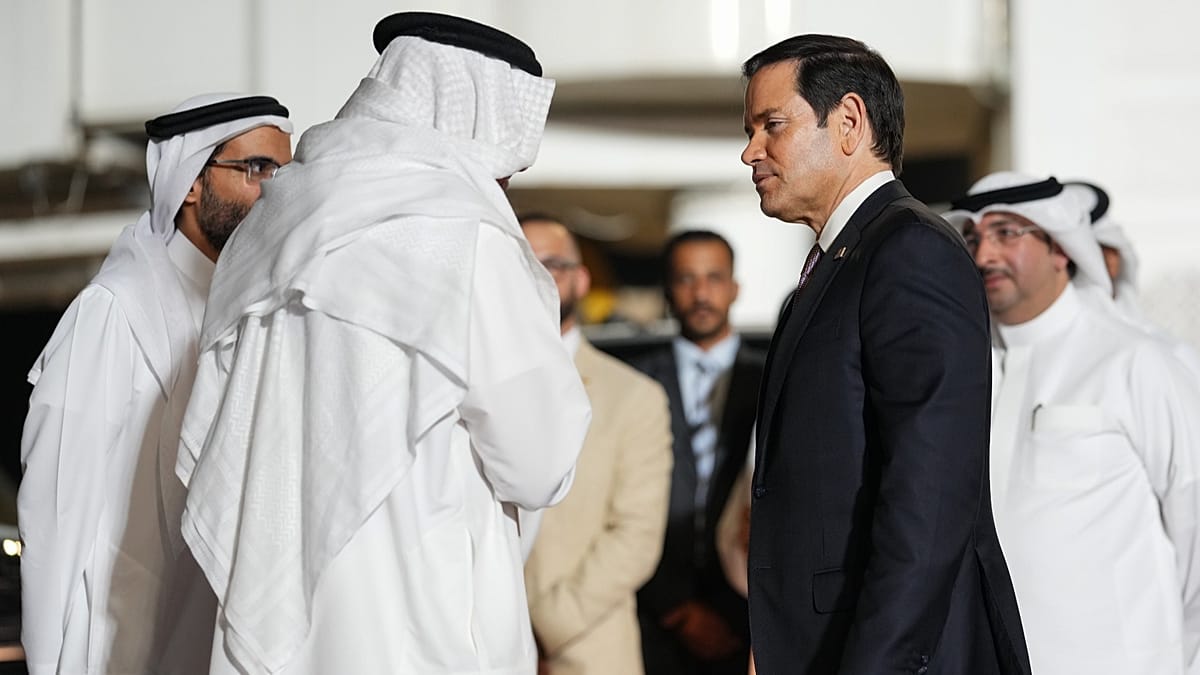
Gulf Cooperation Council (GCC) states — Saudi Arabia, the United Arab Emirates, Qatar, Kuwait, Bahrain, and Oman — convened a summit in Manama on Thursday with US Secretary of State Marco Rubio to address the US-Iran framework deal and outline concrete steps to resume free navigation in the Strait of Hormuz, based on President Donald Trump's repeated assurances that navigation would return to pre-war status.
The joint GCC-US statement emphasized a "strong commitment to the US-GCC strategic partnership" and the need to maintain unity during peace negotiations. It highlighted the shared goal of preventing Iran from acquiring nuclear weapons and addressing the full spectrum of Iranian threats, including ballistic missiles, drones, and support for proxies.
Strait of Hormuz as a Pressure Point
A contentious issue for Gulf states is that under the framework deal, Iran may retain its missile stocks, posing continued danger to the region. The statement underscored that "free, unconditional, and unrestricted navigation, including the right of transit passage as guaranteed under international law, remains essential to regional and global security." Ministers rejected any tolls, fees, or attempts to assert control over the strait.
Meanwhile, Iran's Islamic Revolutionary Guard Corps (IRGC) on Thursday reiterated Iran's claim of sovereignty and control over the Strait of Hormuz, warning ships not to cross without an Iranian permit and attacking a cargo ship. This demonstrates that Iran continues to use Hormuz as a pressure point to sow division among GCC states.
Conditional Economic Engagement with Iran
GCC states stated that future economic engagement with Iran is possible but would be "conditional and reversible, contingent on Iran's compliance with the MOU and the final agreement" and on the "cessation of its destabilising behaviour."
Additionally, the GCC and US declared that the peace negotiations "are not conditional on the outcomes of other conflicts," referencing Iran's demand that Israel end its offensive against Hezbollah in Lebanon. They called for the full disarmament of Hezbollah and Hamas and supported Trump's plan to end the conflict in the Gaza Strip.
Diverging Approaches Ahead
Despite the unified stance, analysts note that differences may emerge as Iran responds. The Institute for the Study of War (ISW) assessed that Iran is likely using discussions called for by the US-Iran MoU to reach arrangements with Gulf states that would allow sustained Iranian influence around the strait in the post-war period. Some Gulf countries, ISW said, "may be amenable" to cooperating with Iran on a broader economic framework.
UAE presidential adviser Anwar Gargash stated that after "treacherous aggression" against the Gulf states, "new geopolitical facts" cannot be imposed. Qatar, which played a decisive role in reaching the US-Iran framework agreement, repeated that relations with Iran will never be the same, but negotiation and dialogue are the only way forward.
Former senior Qatari defense official Nawaf M. Al-Thani wrote: "Serious states do not have the luxury of theatrical foreign policy, and geography does not bend to outrage. Iran remains where it has always been — across the water, tied to the Gulf by trade, energy, security, and proximity." He added that any future relationship will be "colder, stricter, and built on far less faith."