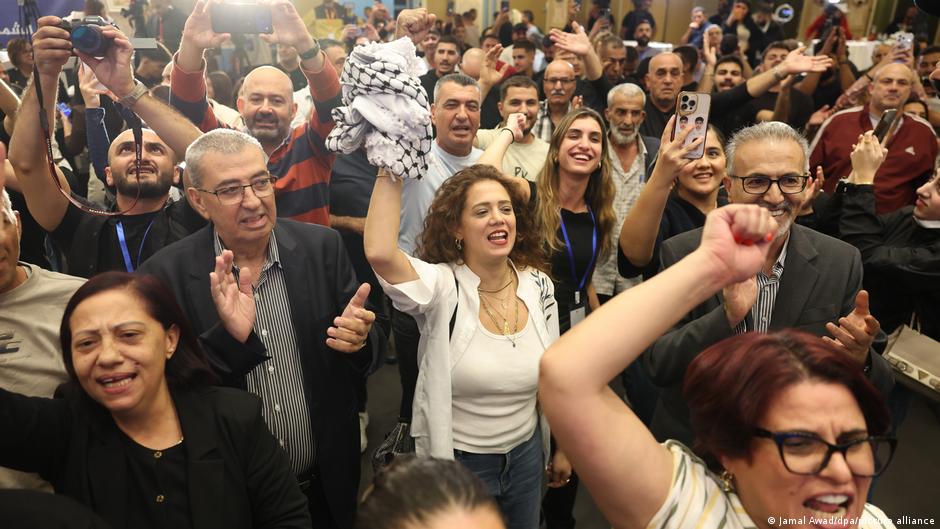
Arab parties could become kingmakers after Israel's inconclusive election
In Israel's parliamentary election, neither Prime Minister Benjamin Netanyahu's bloc nor former general Gadi Eisenkot's opposition is close to a majority. Arab parties, projected to win about 19 seats, may hold the decisive vote.

In Israel's parliamentary election, both main political camps claimed success in the early hours of Wednesday, yet neither is near a governing majority. With more than 85 percent of votes counted, the Arab parties – the Joint List and Ra'am (the United Arab List) – are projected to win about 19 seats and could play a decisive role in forming a government. A coalition needs 61 of the 120 seats in the Knesset, Israel's parliament.
Prime Minister Benjamin Netanyahu told supporters at Likud party headquarters in Jerusalem that Likud was the largest party and called for a strong right-wing nationalist government. His main rival, former general Gadi Eisenkot, declared victory for "Israel's Zionist national majority" in Tel Aviv. Partial results put Netanyahu and his allies at around 53 seats, while Eisenkot's "Change" bloc was just under 50.
Arab voter turnout
The Arab parties' gains were driven by the highest turnout in almost three decades, at more than 77 percent. Arab Israelis, mainly of Palestinian descent, make up about 21 percent of the population but usually vote in much lower numbers. In 2022, the last election before the October 7 attacks, the Arab bloc won just 10 seats. Ra'am leader Mansour Abbas pledged to turn this strength into political influence.
Sylvaine Bulle, an Israel expert at the School for Advanced Studies in the Social Sciences (EHESS) in Paris, said Arab voters had "woken up" in response to Gaza and, above all, the occupied West Bank, where settler violence has risen and Netanyahu's far-right coalition partners have threatened formal annexation.
Conditions for cooperation
Netanyahu warned Eisenkot against building a government that relies on "anti-Zionist" Arab parties. Cooperation would be difficult for Eisenkot, as it could alienate Jewish voters, particularly on the right. He has set four conditions: recognising Israel as a Jewish and democratic state, accepting the principles of its declaration of independence, extending conscription to Palestinian citizens of Israel, and denouncing Hamas as a terrorist group.
The moderate Islamist Ra'am, part of Naftali Bennett's coalition in 2021, has signalled openness to working with him. Amjad Shbita, head of the largest party in the Joint List, rejected the conditions and said talks would be held "as equals". Yair Golan, leader of Israel's main left-wing party, urged a government of change in partnership with Arab citizens. Final results are still pending, and forming a government may take time.