Kashmir's potato pits are vanishing, and generations of knowledge with them
In Gurez, a high-altitude valley in Indian-administered Kashmir, fewer families use traditional underground pits to store potatoes over winter. Scientists warn that local potato varieties and the knowledge around them could be lost.
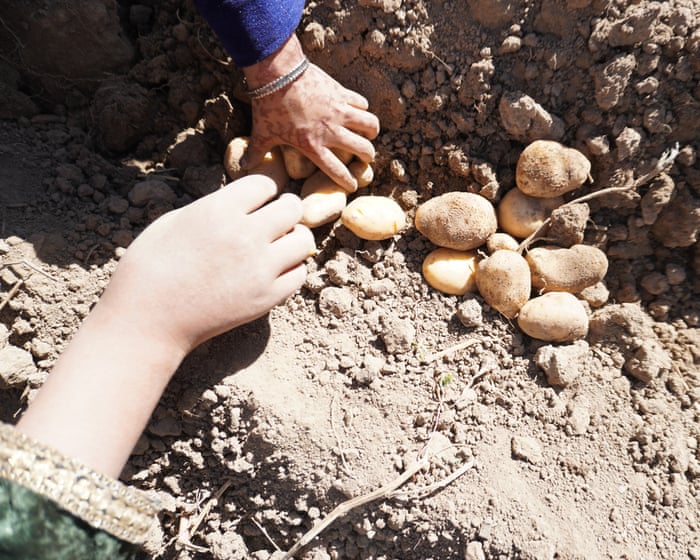
In Gurez, a high-altitude Himalayan valley in Indian-administered Kashmir near the Line of Control, the heavily militarised boundary between the Indian- and Pakistani-administered parts of the region, a traditional food-storage method is fading. Underground pits known as khraw, used to keep potatoes through winter, are being abandoned, and with them may go local potato varieties and the know-how to grow them.
How a khraw works
A khraw is a pit in the ground lined with straw and sealed against the cold. In Gurez, snow cuts villages off from the rest of the Kashmir valley in winter, and temperatures fall below -20C. For generations the pits have kept potatoes, turnips and cabbages.
Hajra Begum, 40, from the village of Chorwan, sorts her harvest before storing it: some potatoes are for the family's food, others for planting in spring. She learned from her mother how to tell potatoes that store well from those that rot or sprout too soon, and she is teaching her daughter, but she is unsure the skill will survive another generation. She recalls that almost every family once had three or four pits, while in the main valley the practice has been dropped almost entirely.
Loss of varieties
Gurez lies about 125km from Srinagar, and its main road link, Razdan pass, closes under snow each winter. Potatoes make up about 45% of the valley's cultivated area, according to a 2019 study by the Indian Council of Agricultural Research's National Bureau of Plant Genetic Resources (ICAR-NBPGR), a government body that conserves India's crop diversity. The genetic diversity of the valley's potatoes has not been systematically documented, however.
Dr Sheikh M Sultan, a senior scientist at ICAR-NBPGR, says he later could not find some varieties he had seen earlier. He cites migration, better roads and changing lifestyles, and notes that research institutions often favour introduced varieties over indigenous ones.
Climate change adds pressure: residents report drier springs, less snow and water shortages. Farmland is also lost to the Kishanganga hydroelectric project, which has affected areas such as Badwan, a village known for its potatoes.
Geographical indications are one possible route to protecting the varieties, but experts stress that recognition alone is not enough. The varieties and farmers' knowledge must be documented while they are still grown.