Chinese Drone Swarm Maps Woods on Its Own, Code Not Released
Researchers at Tongji University in Shanghai developed ESCAPE, a framework that lets a drone swarm map trees and indoor spaces with no pilot or central control. The paper's authors say the code is not public, citing research confidentiality.
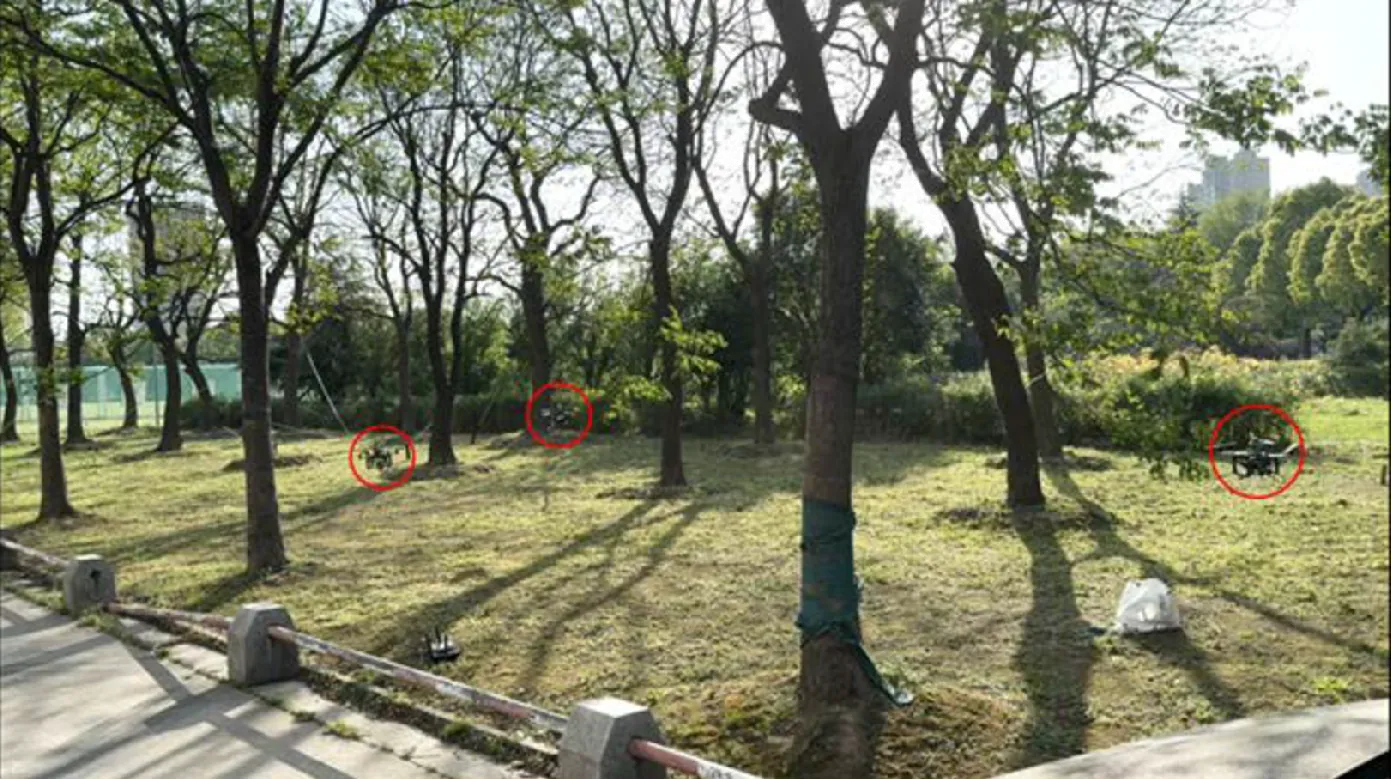
Three lidar-equipped quadcopters from Tongji University in Shanghai, China, explored a patch of park trees with no ground station and no pilot. Four identical drones mapped an exhibition hall with columns and a display board. The framework, called ESCAPE, was described on December 22, 2025 in Autonomous Intelligent Systems, a journal published by Springer. The authors come from Tongji University, Tianjin University and the Beijing Institute of Technology. The paper states the code is not available to the public because of the confidentiality requirements of the research.
How the swarm works
Each drone carried an Intel NUC computer and a Livox Mid-360 lidar, and made all flight and collision-avoidance decisions on board. The search area is divided into uniform grid cells, which the drones trade in pairs with no hub giving orders. Each then chooses its own visiting order and flies at 1.0 m/s while building a 3D map.
The system builds on Racer, a 2023 framework from the Hong Kong University of Science and Technology. The main change is an extra cost when a cell's center lies inside a wall or tree trunk, intended to stop a drone from shuttling back and forth in front of a large obstacle.
For collision avoidance, drones broadcast their positions. When two come within a 1.5-meter safety bubble and head toward each other, the higher drone replans around the lower one, which brakes and hovers.
Results and limits
In simulations on three office maps, ESCAPE finished exploring faster than Racer on average in seven of nine configurations, and faster than ETH Zurich's Role framework in all nine. In the third office with two drones, ESCAPE averaged 98.9 seconds against Racer's 140.4. The simulations assumed perfect localization and communication. The paper gives no collision counts or packet-loss figures from the physical flights.
The work was funded by Chinese public science programs. The paper mentions only civilian uses, such as forest search and rescue. It does not explain why the code is withheld.