Russia and North Korea finalising first road crossing amid concerns it serves as Ukraine war supply route
The first road bridge between Russia and North Korea is nearly complete, officially for trade and tourism. However, an investigation suggests it is intended as a military logistics corridor to support Russia's war in Ukraine.
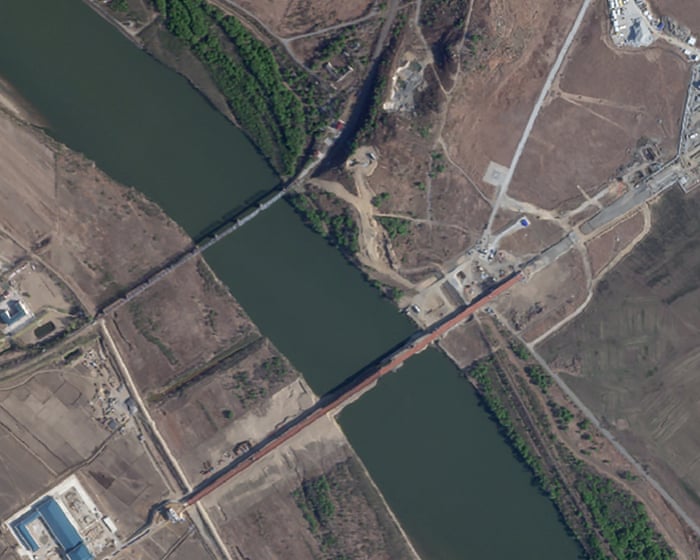
Russia and North Korea are close to completing the first road bridge ever built between them, raising concerns that the increasingly close allies are creating infrastructure to boost military cooperation in the Ukraine war.
The bridge spans the Tumen River between Khasan in Russia's far east and Tumangang in North Korea, a remote, thinly populated border area. North Korea has finished its side, including customs and quarantine facilities, targeting a 19 June opening, but Russia has fallen behind schedule, and no new opening date has been set.
Officially, Russian and North Korean authorities say the bridge is intended to expand trade and tourism. North Korea's state media, KCNA, describes it as a way to boost "travel of persons, tourism and circulation of commodities." However, an investigation by Ukrainian human rights group Truth Hounds, shared with the Guardian, suggests it is designed primarily as a discreet military logistics corridor.
Nazar Myhun, who led the open-source research, said a key reason for this conclusion is that roads are much harder to monitor via satellite than railways. Trucks look almost identical in satellite imagery, whereas railcar types reveal much about cargo. Loading and unloading trucks is also faster. The new road bridge runs alongside the Friendship Bridge, the only rail link between the two countries.
The economic rationale is weak: the bridge is estimated to have cost more than $100m, while bilateral trade in 2024 was reportedly only $34m. Tourism from Russia to North Korea remains tightly controlled, with around 10,000 Russian visitors in 2025. Pyongyang, where most foreign tourists go, is over 500km from the crossing.
Instead, the investigation concludes the bridge is strategic infrastructure for moving North Korean troops, construction brigades and military officials into Russia, and Russian technology and resources in the opposite direction. The bridge is about 1km long, 7m wide, with two lanes, part of a 4.7km crossing that includes approach roads. A helicopter landing pad is also being built on the Russian side.
Construction began after Vladimir Putin and Kim Jong-un signed a comprehensive strategic partnership pact in June 2024. More than 14,000 North Korean troops have fought alongside Russian forces in Kursk, and President Zelenskyy has warned that Russia is preparing to receive a further 30,000 soldiers. At least 2,000 North Korean servicemen are believed to have died. The Kremlin has not responded to the investigation's claims.