Late-Autumn Nitrogen on Corn Residue May Be Wasted Money
Polish farming portal farmer.pl says applying nitrogen to speed up the breakdown of corn residue after a late harvest is not always economically or agronomically justified. In some cases it is better to wait until spring.
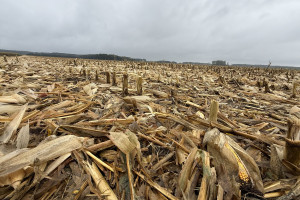
In Poland, the harvest of grain corn sometimes runs to the end of November or even December. After the combine passes, large amounts of crop residue remain in the field, and many farmers try to speed up its breakdown with nitrogen fertiliser. According to the Polish agricultural portal farmer.pl, in late autumn this does not always pay off.
Why nitrogen helps decomposition
Corn stalks contain a lot of carbon, which is an energy source for soil microorganisms, but these also need nitrogen. A tonne of corn residue contains on average about 8–10 kg of nitrogen, and roughly 3–4 kg per tonne may be missing to balance the needs of decomposition. For 10 tonnes of residue, that theoretically means an extra 30–40 kg of nitrogen per hectare. That does not mean such a dose should be applied automatically: the mineral nitrogen already in the soil, the timing and the weather also matter.
Cold limits the effect
In November soil temperatures are lower than in September or October, and microbial activity drops. If temperature is the limiting factor, fertiliser will not noticeably speed up decomposition. Unused nitrogen can also be leached over autumn and winter. If spring crops are planned after corn, fertilisation can be moved to spring and the microorganisms' needs included in the nitrogen balance for the following crop. Farmers should also remember immobilisation, the temporary binding of nitrogen by microbes, which can compete with growing plants in spring.
Regulatory limits
Under Poland's nitrate programme, the standard deadline for applying mineral nitrogen fertilisers on arable land ends on 20 October, and in some municipalities on 15 or 25 October. If unfavourable weather prevented harvest or fertilising on time, the work may be done later, but no later than 30 November. For autumn crops sown after late-harvested preceding crops, fertilising is allowed longer, but the nitrogen dose may not exceed 30 kg per hectare and dates must be documented. Fertilising frozen, snow-covered, waterlogged or saturated soil is prohibited.
The portal concludes that the decision should depend on harvest date, soil temperature, soil nutrient status and the planned following crop.