Two years after Latvia's e-cigarette flavour ban, legal sales have shrunk and illegal market may reach half
Latvia's ban on flavoured e-cigarette liquids, in force since early 2025, has sharply cut legal sales. The author of an analysis argues the illegal market may account for about half of the total and that the rules should be reviewed.
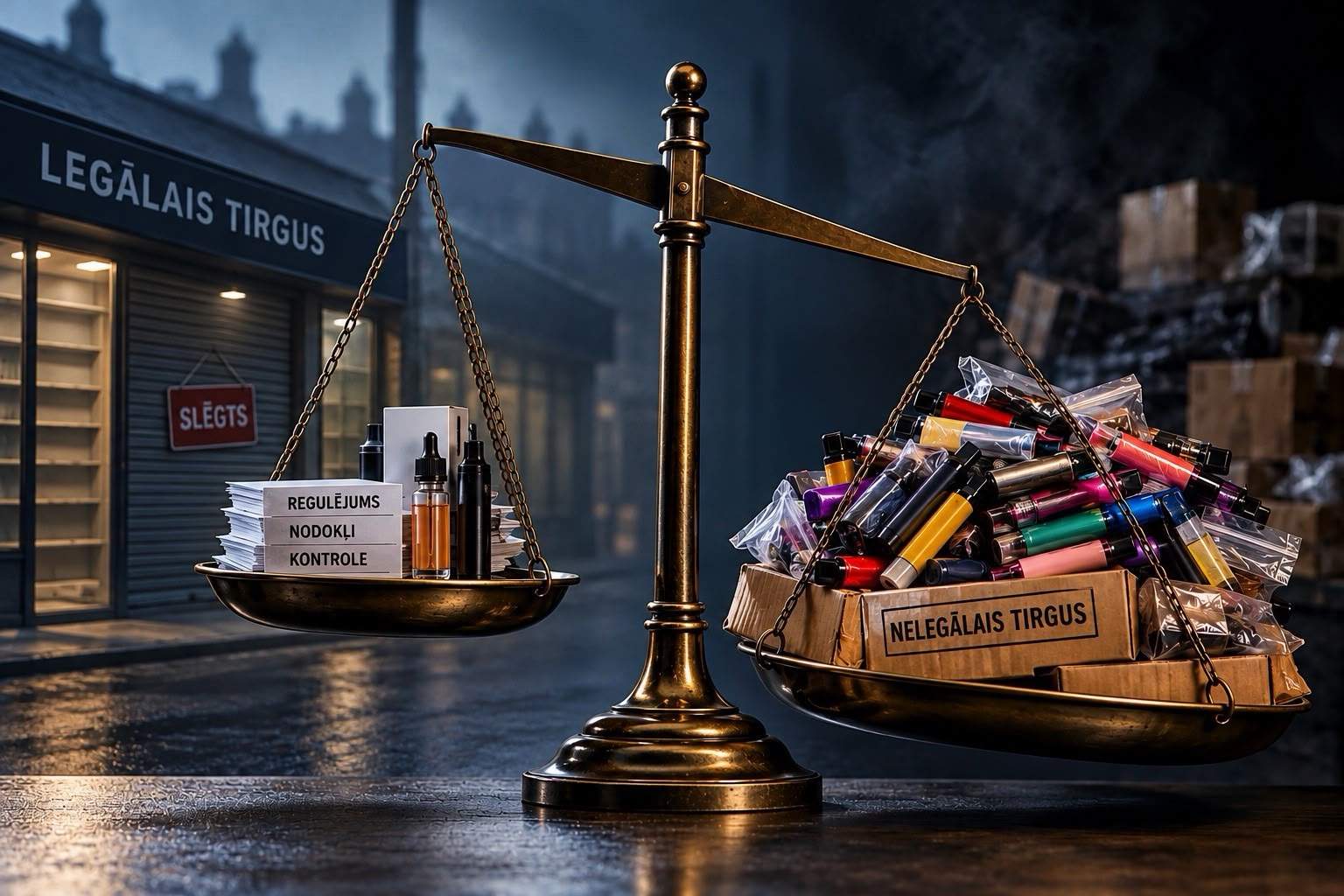
Almost two years after Latvia banned flavoured e-cigarette liquids, legal sales have dropped sharply, while the illegal market may account for roughly half of the total market, according to publicly available information cited in an analytical article published by the newspaper Latvijas Avīze on 26 October. The author calls for the current rules to be reviewed.
What was banned
On 1 January 2025, amendments to the law governing tobacco products, electronic smoking devices and their liquids took effect. They prohibited products with flavours, except those that produce a tobacco taste. The restrictions were justified on public health grounds: the aim was to make e-cigarettes less appealing to children and young people and to reduce their use.
What the data show
Data from the State Revenue Service cited in the article indicate that legal sales of e-cigarette liquid fell by 42.5% in 2025 compared with 2024. In the first eight months of 2026 they dropped a further 4.7% against the same period last year. The author argues that demand has not disappeared but has shifted to illegal channels, where age limits and composition requirements are not observed. On the size of the illegal market, the article refers to Latvian State Police information and a 2025 study by Arnis Sauka, a professor at the Riga Business School.
Tax revenue
The excise rate on the liquid is rising: €0.24 per millilitre in 2024, €0.29 in 2025, €0.35 in 2026 and €0.40 planned for 2027. In the author's model, which assumes legal sales had stayed at 2024 levels, the excise revenue gap exceeds €6 million in 2025, approaches €8 million in 2026 and reaches €9 million in 2027. Including value-added tax, the modelled gap is about €15 million in 2025 and over €20 million in 2027.
Approaches elsewhere
The article notes that the European Union has no uniform flavour ban and that most member states allow a wider range of products. As an alternative, the author points to restricting specific substances or setting concentration limits. Germany is in the process of approving such rules, and the Czech Republic has applied them since December 2025.