London's Wiener Holocaust Library examines the antisemitic press storm of the Dreyfus affair
The Wiener Holocaust Library in London opens an exhibition on 5 November about the Dreyfus affair and the antisemitic press it provoked. The items show how hostile material spread in late 19th-century France after censorship was lifted.
The Wiener Holocaust Library in London, described as the oldest Holocaust archive, opens an exhibition on 5 November titled "J'accuse! Press, Polemic and the Dreyfus Affair". It is devoted to the Dreyfus affair in France and the press coverage the scandal generated, and runs until 19 March. It marks 120 years since army captain Alfred Dreyfus was exonerated, promoted and awarded the Legion of Honour.
The scandal and the press
The affair began in 1894, when Dreyfus, a 36-year-old French army captain who was Jewish, was wrongly convicted of treason. His accusers argued that a Jewish man's loyalty to the French republic was questionable, and the clash with his defenders set off a flood of newspaper specials, journals and posters. Barbara Warnock, co-director of the library, calls it the world's first case of antisemitism "going viral" and says the subject is relevant today.
The library was founded by Alfred Wiener, grandfather of the Conservative peer Daniel Finkelstein. After the Nazis rose to power, he left Germany for the Netherlands in 1933 and moved from Amsterdam to London in 1938, bringing a collection of documents on the growth of antisemitism.
The exhibits
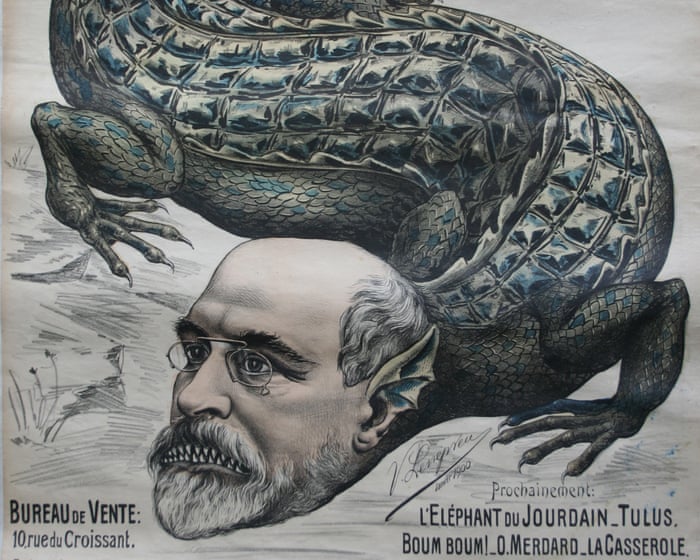
About 40 Dreyfus items are on show. Some were sourced by Wiener, others were gathered by the library over the following decades, and a further group is on long-term loan from Birkbeck, University of London. Among them is a poster from the series "Musée des Horreurs" showing Arthur Ranc, a leftwing politician and newspaper editor who backed Dreyfus, as an alligator-like creature. Curator Clara Dijkstra says the series ran from autumn 1899 to 1900, with 45 to 50 versions, and aimed to dehumanise Dreyfus's defenders. After about a year the government shut down publication as too grotesque.
Also displayed are an issue of the rightwing paper La Libre Parole with antisemitic imagery on its cover, and a 45-page special edition of the British illustrated weekly The Graphic headlined "Dreyfus the martyr", which focuses more on the miscarriage of justice. Another item is the image "Psst…!" from a French journal, published in response to Émile Zola's open letter "J'Accuse", in which he accused the government of antisemitism and a cover-up.


