Game of Stones: How Paintings of Marble Reveal Medieval Mysticism
A new book explores how medieval and Renaissance artists depicted marble as a living, mystical substance, breaking perspectival rules to evoke the divine.
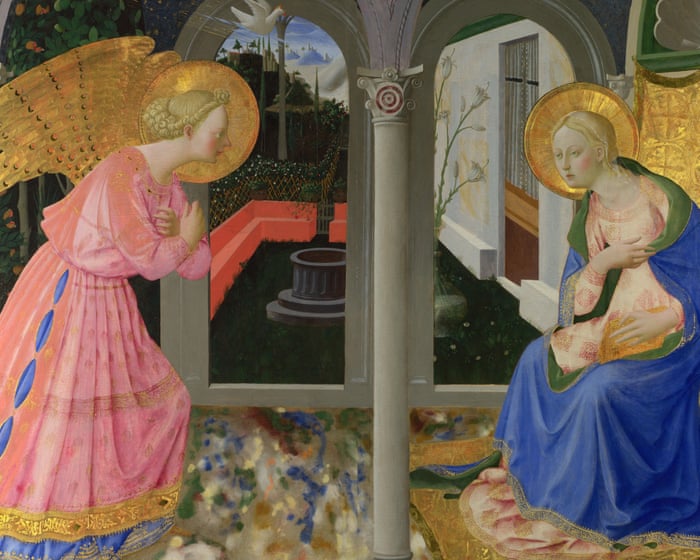
Today, marble is seen as a luxury commodity—think high-end kitchens and corporate lobbies. But before the Enlightenment and the birth of geology, people viewed marble as a mysterious, living material with spiritual properties. In his new book "Divine Presence," creative director Karl Kolbitz delves into this pre-scientific mindset, showing how artists in the Middle Ages and Renaissance used marble not just as decoration but as a gateway to the divine.
Kolbitz points out that depictions of marble often ignored the rules of perspective. They could be wildly abstract, with swirling colors that seemed to belong to another world. This wasn't mere whimsy; it reflected the belief that divinity permeated all matter, including stone. For instance, Zanobi Strozzi's "Annunciation" (1440-45) features a marble floor so abstract it contrasts sharply with the controlled figures. Piero della Francesca's "Annunciation" (c. 1467-69) uses solid blue marble to blur the line between earth and heaven.
Other examples include Andrea Mantegna's "Lamentation Over the Dead Christ" (c. 1483), where marble patterns evoke the bloodied body of Christ, and Giotto's Scrovegni Chapel (c. 1303-05), which mimics the "book-matching" technique of cut marble. The book also highlights a fascinating practice: painting the back of panel paintings (the verso) to resemble marble, elevating humble wood to the status of gem-studded reliquaries. Kolbitz's own book cover features Albrecht Dürer's "Christ as the Man of Sorrows" verso.
Kolbitz argues that marble's appeal lies in its straddling of the legible and illegible—its patterns attract the eye while confusing it with a semblance of natural chaos. The book is not an academic survey but an invitation to see overlooked details in art. "We are far removed from the realities of people living in the 14th and 15th centuries," Kolbitz writes, "yet traces of their ways of thinking still persist in contemporary life," citing our fascination with crystals and astrology.