Providus Director: Delays in Forming Saeima Committees Limit Oversight of Government
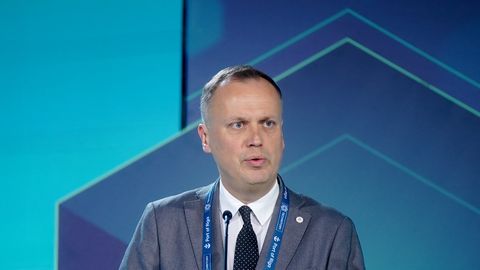
Sanda Liepiņa, director of the think tank Providus, says delays in setting up Saeima committees hamper parliament's work and its oversight of the government. She also criticises the lack of clarity on the incoming government and the slow budget process.

Sanda Liepiņa, director of the Latvian think tank Providus, says delays in setting up Saeima committees restrict parliament's ability to advance issues and scrutinise the government. In her view, this interim state, following the 3 October parliamentary election, must not drag on. Without committees for a prolonged period, the Saeima effectively does not exercise its oversight function over the executive.
Forming the government
Liepiņa noted that the time spent forming a government is not exceptional in itself. The problem is the lack of clarity about the incoming government's outline, the division of responsibility and the cooperation model. It remains unclear whether the United List (AS) wants to form a government alone or with partners.
Providus data on ten Saeima elections since 1993 show that approving a government has taken 53 days on average, with a median of 41 days. The fastest was after the 2006 election (31 days) and the slowest after the 2018 election (109 days). If a government were approved on 18 November, 46 days would have passed since the election.
The budget
Liepiņa called the slow and unclear budget process a significant problem: without clarity on state finances, subordinate institutions cannot plan their work on time, and uncertainty may affect the economy. At today's cabinet meeting, the first budget-related legal acts were due to be considered, but their review was postponed.
In Lithuania, budget deadlines are set in the constitution, and in the last three election cycles the budget was adopted before the new year. In Latvia, in six of ten post-election cycles the new year began without an adopted budget; after the last two elections the budget was adopted in April 2019 and March 2023.
Prime minister and finance minister
Liepiņa commented on prime minister candidate Andris Kulbergs (AS), who said a deficit-free budget in 2030 is not possible. She said it raises questions that he reportedly did not know about this earlier. According to her, Finance Minister Māris Kučinskis (AS) has begun explaining budget choices more fully in public, creating a situation in which "one prime minister is in the cabinet, another in the Saeima".
At a press conference Kulbergs said he wants Latvia to reach the 2018 financial situation by 2030, which would require saving €2.875 billion in the budget over four years. He aims to raise the number of workers to 909,000, which would be 26,000 more than in 2025 and bring in roughly €290 million more in taxes each year.