Riga East University Hospital surgeons perform rare aortic and branch artery reconstruction
Surgeons at Riga East Clinical University Hospital performed a technically complex open reconstruction of the aorta and its branches on a patient with severe atherosclerosis. The patient has been discharged and is continuing recovery in rehabilitation.
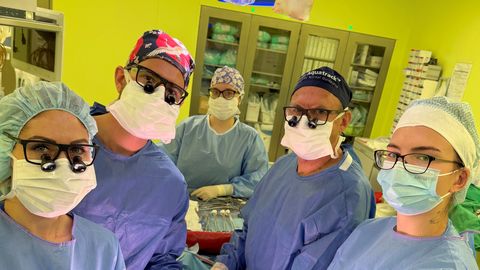
Surgeons at Riga East Clinical University Hospital (RAKUS) have carried out a rare and technically complex reconstruction of the aorta and its branches on a patient with severe atherosclerosis, the hardening and narrowing of the arteries. The aim was to restore blood supply to the abdominal organs and the lower limbs, the hospital said. Less invasive options were not suitable in this case, so a major open operation was required.
The patient's postoperative recovery has been satisfactory. They have been discharged and are continuing to recover in rehabilitation.
Why open surgery was chosen
Before the operation, the patient had marked limits on movement and constant abdominal pain that worsened after eating. The hospital explained that such symptoms can appear when narrowed or blocked arteries leave organs and tissues without enough blood, so they can no longer function properly. In this case, the disease affected the blood supply both to abdominal organs and to the lower limbs.
Vascular surgeon Pāvels Žibenko said that minimally invasive methods, which widen vessels from the inside using catheters and stents, carried higher risks than a large operation here. Surgeons therefore needed access to both the abdominal and chest cavities. During the procedure, the aorta was controlled and several arteries were reconstructed, restoring blood flow in critically important vessels. The hospital noted that such operations are demanding because surgeons must work on the aorta and several of its branches at once while preserving the blood supply to vital organs.
Minimally invasive versus open surgery
Patrīcija Ivanova, chief physician of the hospital's Vascular Surgery Department, said that in modern vascular surgery, minimally invasive, or endovascular, treatment is increasingly the first choice, in up to 80% of cases where anatomically and clinically possible. She argued, however, that this case shows why open vascular surgery skills must be preserved and developed alongside advanced technologies.
Ivanova stressed that the task is not to choose between the two approaches but to give each patient the most suitable treatment. The hospital added that the experience of vascular surgeons, together with the anaesthesiology, operating nurse and postoperative care teams, matters in treating such patients. Offering both complex endovascular and open surgery in one place allows doctors to choose tactics according to each patient's anatomy, severity of disease and individual risk.