Rembrandt painting altered to erase turban restored to original state
Restorers have removed overpaint from a 17th-century Rembrandt, revealing that a turbaned figure was later replaced with a Dutch cap. The work, reflecting the artist's stance on religious tolerance, will be auctioned by Sotheby's with an estimate of £8–12 million.
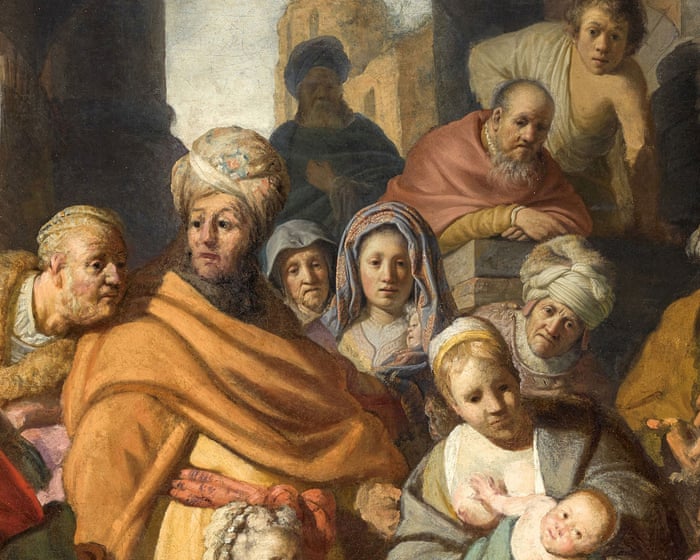
Restorers working on a 17th-century painting have removed layers of overpaint, confirming it as an authentic Rembrandt and revealing that a man originally wore a turban, later replaced with a traditional Dutch soft cap by an anonymous hand. The later painter apparently misunderstood the biblical theme, “Let the Little Children Come Unto Me,” which emphasizes tolerance, and made the scene more conventional.
Rembrandt originally depicted a diverse crowd, including Jewish and Christian figures, as well as the man in the turban. Art historian Andrew Graham-Dixon noted the painting aligns with Rembrandt's connection to the Remonstrants, who advocated for religious tolerance. In 1627, when Rembrandt began the work, Leiden was overwhelmed by refugees from the Thirty Years' War – the city took in about 10,000 refugees that year. Graham-Dixon called the painting a statement of Rembrandt's moral position in favor of humanitarian relief.
The painting, measuring 106 cm by 80.5 cm, was discovered in 2014 at a German auction, listed as an anonymous Netherlandish work. Now attributed to Rembrandt, it will be auctioned at Sotheby's London on 1 July with an estimate of £8 million to £12 million, reflecting its significance as one of the most important early Rembrandts in private hands. Alex Bell, chair emeritus of Sotheby's UK, said the overpainting simplified and sanitized the original, and the restoration reveals a more striking, diverse composition.
Rembrandt had painted a naked child, whom the later artist clothed. Research shows the painting includes family members – his parents and himself as a young man looking directly at the viewer. Bell remarked that no other Rembrandt brings his family together so completely. The public can view the restored painting from 27 June at Sotheby's London, the first time it will be seen as Rembrandt intended.