Wildfire forces evacuation of NASA's Deep Space Network complex in Spain
A wildfire near Madrid has forced the evacuation of NASA's Deep Space Communications Complex and a nearby ESA station. The network now relies on a single 70-meter antenna in Australia.
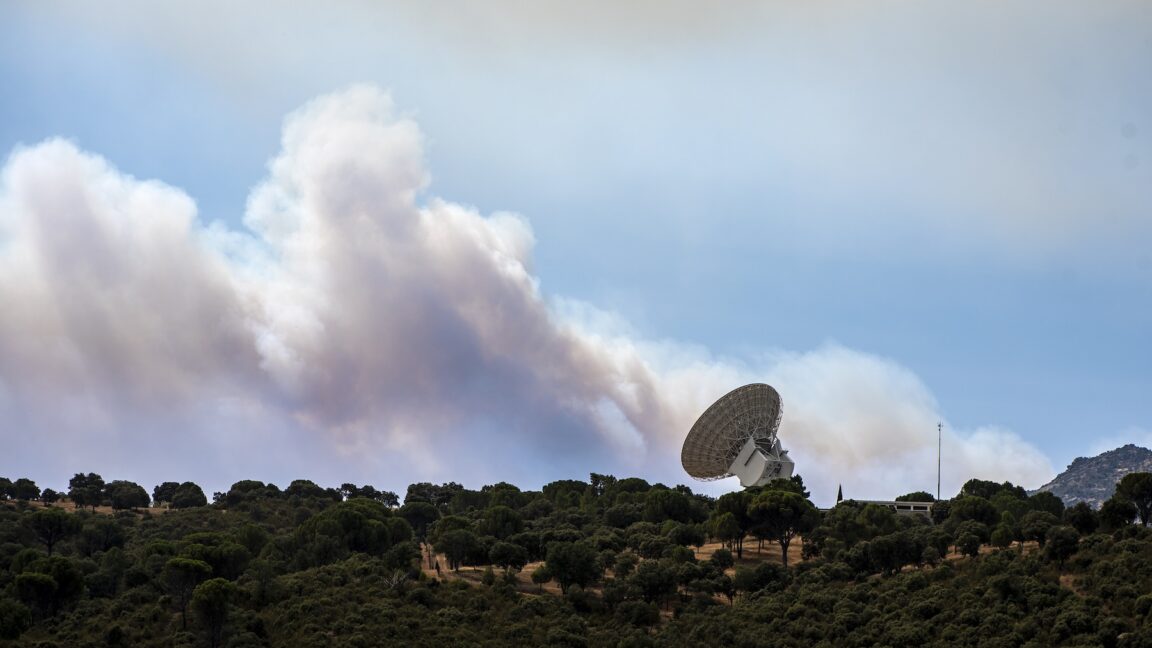
On Friday afternoon, the Madrid Deep Space Communications Complex, part of NASA's Deep Space Network (DSN), went off-line due to wildfires in the region. A NASA status website showed no activity at the Madrid site, while antennas in California and Australia continued communicating with spacecraft such as Voyager 2 and Juno.
NASA stated that personnel safety is the top priority and expressed concern for affected communities. Spanish authorities ordered the evacuation of more than 19,000 people from towns in the mountains west of Madrid, deploying over 2,000 personnel and 10 aircraft to fight the fires. A summer heat wave and chronic drought have created favorable conditions for wildfires across Spain and France.
The Cebreros tracking station, jointly operated by the Spanish government and the European Space Agency (ESA) and located a few miles from the NASA facility, was also evacuated due to the fires.
With the Madrid site offline, DSN is now down to one operational 70-meter radio antenna in Australia. The 70-meter antenna in California has been out of service since last year due to an accident where it over-rotated, damaging cables and water lines. The incident caused 200,000 gallons of water containing glycol to flood the antenna base, posing an environmental hazard. Repairs and cleanup are estimated at $4.1–$4.6 million, and NASA is combining them with planned upgrades. The antenna is expected to remain offline into 2028.
Fortunately, the next Artemis mission to the Moon is still at least a couple of years away. Artemis III will fly in low-Earth orbit to test the Orion capsule with commercial lunar landers, while Artemis IV, the first planned crewed lunar landing, is targeted for no earlier than 2028.