Witkoff and Kushner Put European Security on Peace Talks Agenda, a Move That Suits the Kremlin
US presidential envoys Steve Witkoff and Jared Kushner have added European security architecture to the Ukraine–Russia peace talks. The Financial Times says this serves Russian President Vladimir Putin's interests, while European leaders insist such discussions should begin only after a ceasefire.
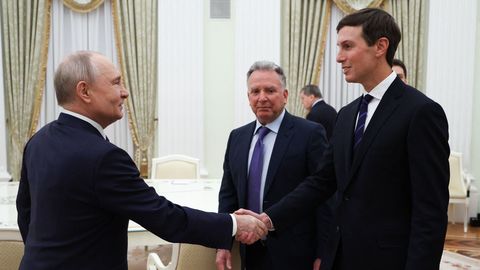
Steve Witkoff and Jared Kushner, special envoys of the US president, have broadened the agenda of the Ukraine–Russia peace talks by adding the question of European security architecture, in an effort to revive the negotiations. The Financial Times reports that the move was met with considerable satisfaction in the Kremlin, as Russian President Vladimir Putin has long demanded that the so-called root causes of the war be addressed.
According to the Kremlin's reasoning, the main root cause is the set of organisations, treaties and norms underpinning European security. European leaders, for their part, say substantive talks on security mechanisms should take place only after a ceasefire in Ukraine. In their view, agreeing to the issue at the start of peace talks would mean walking into a trap set by Russia. The US envoys acknowledge that a deal on Ukraine is impossible without Europe and say Europeans will take part in the next round of talks.
Experts: Moscow seeks extra leverage
John Loaf, head of the foreign policy department at the London-based think tank Nest Centre who specialises in Russia, believes the American envoys acted in Putin's favour and that this will only embolden the Russian leader. Many experts see Russia's push to rewrite the post-Cold War order as a manoeuvre to distract from its invasion of Ukraine. Some do not rule out that Moscow wants to restore its dominance in Eastern Europe and prevent further NATO enlargement.
The Financial Times recalls that Vladimir Medinsky, Russia's chief negotiator at this week's talks in Abu Dhabi, earlier called for a "new Yalta and Potsdam" — conferences at which Allied leaders divided post-war Europe into spheres of influence. Analysts note that discussing security architecture before a ceasefire would give Moscow additional pressure tools against Europe's long-term financial and military support for Ukraine, and could also drive a wedge between Europe and the US.
Proposals on the table
Last week Kushner said the US is considering five goals: permanent consultations on security issues, reliable communication channels in crises, greater military transparency, reciprocal measures to reduce escalation risks, and a solid basis for long-term security in Europe. He stressed that NATO would remain the central element of Europe's collective defence.
US officials have also floated restoring the NATO–Russia Council, a consultative body created in 2002 that gave Russia a say in alliance discussions. Moscow effectively walked away from it while preparing for war against Ukraine. The Russian Foreign Ministry has previously suggested that non-aggression pacts between individual NATO members and Russia could be signed; analysts say this would render the alliance's mutual defence guarantee meaningless.
BBC Russia editor Steve Rosenberg has noted that the Kremlin has again pulled out the "draft treaties" with the US and NATO it put forward in December 2021. They would have halted NATO's eastward enlargement and withdrawn the alliance's military infrastructure from Central and Eastern European countries that joined after the Soviet collapse.