Jodrell Bank faces closure as UK physics funding crisis deepens
The UK's world-class Jodrell Bank Observatory and e-Merlin network are threatened with closure due to STFC funding cuts, while other facilities face significant reductions, leading to a potential brain drain of physicists.
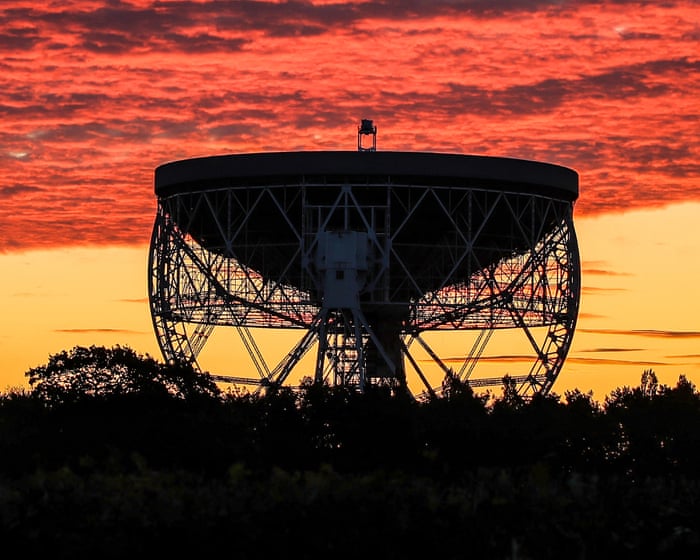
In December 1945, physicist Bernard Lovell from the University of Manchester ventured into the Cheshire countryside to study cosmic rays using an army surplus radar. He discovered radio reflections from meteor trails, marking the birth of radio astronomy at Jodrell Bank. A year later, engineers mounted the radar on a searchlight base, and by 1957, the Lovell Telescope—the world's largest radio telescope at the time—was completed, capable of tracking the Soviet Sputnik satellite.
Decades of upgrades kept Jodrell Bank at the forefront, serving as the heart of the seven-telescope e-Merlin network, the UK's national radio astronomy facility. However, the network and the observatory itself now face closure. The Science and Technology Facilities Council (STFC) plans to end funding by March 2028, halting all observations unless alternative support emerges.
Radio astronomy has transformed our understanding of the universe, from detecting spinning neutron stars to imaging black holes and the big bang's afterglow. Yet other UK astronomy projects are also hit hard. The Rubin Observatory in Chile, set to create the largest cosmic movie, will see UK involvement drop by 20%. Work at the La Palma observatory and the Bison solar network will fall by 40%, and the UK is withdrawing from the Event Horizon Telescope, which captured the first black hole image.
The STFC says it must save £162m by 2030 due to soaring electricity, staff, and exchange rate costs for international collaborations like CERN. However, figures from Research Professional News suggest a combined forecast cost overrun of £684m over four years.
Other physics facilities are not spared. The Diamond synchrotron and Isis muon and neutron source face cuts but remain operational. The Clara particle accelerator test facility is being mothballed, and the Boulby underground lab's budget is slashed by 40%. The LHCb experiment on the Large Hadron Collider may end prematurely without funding, leaving 80% of data uncollected.
A recent survey found that nearly 80% of early-career physicists are considering leaving the UK due to the funding crisis. Losing even a fraction would be a blow to UK science and economic growth. The challenge now is to convince them to stay.
/nginx/o/2026/08/04/17827659t1h2bcd.jpg)