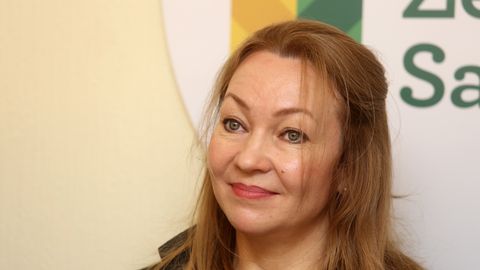
Political Scientists: Uncertainty Surrounds Formation of Latvia's New Government, Minority Cabinet Seen as Short-Lived
Political scientists Iveta Kazoka and Oskars Skudra say it is still unclear what form Latvia's next government will take. They do not expect a minority government backed by Ainars Slesers' party to succeed in the long run.

Talks on forming a new government in Latvia after the parliamentary election continue, but their outcome remains unclear. Political scientists surveyed by the news agency LETA say it is not yet possible to predict with confidence the composition or working principles of the next cabinet. They believe an attempt may be under way to build a highly centralised leadership model and a minority government supported by Ainars Slesers' party "Latvia First" (LPV), but they do not foresee lasting success for it.
Kazoka: a mess with no visible strategy
Political scientist Iveta Kazoka describes the current talks as a big mess behind which no clear strategy can be seen. In her view, the United List (AS), whose representative Andris Kulbergs is prime minister, could have started work with strong public trust after its convincing election result, but has not yet used that opportunity. She welcomes pledges of serious reforms and the plan to base the government declaration on a shared vision.
Kazoka also warns about an overly centralised leadership style and doubts that AS has the experience and organisational ability to sustain a minority government for long. She says such a model requires great political skill, a disciplined party and good relations with the opposition. Prolonged uncertainty could also reduce potential coalition partners' willingness to join.
Skudra: deadlines and the EU budget
Political scientist Oskars Skudra disagrees that the talks have dragged on significantly. He notes that the 15th Saeima will begin work on 3 November, and on 4 November President Edgars Rinkevics has promised to formally task Kulbergs with forming the government. The government must be in place by 18 November; within that time, he sees a minority AS government, or an AS and National Alliance government backed by another force, as the most realistic options.
Skudra believes Kulbergs may not hurry also because a European Council meeting on the EU multiannual budget for 2028–2034 is expected at the end of November. The budget affects projects such as Rail Baltica. He sees a minority government as a temporary solution without a full mandate for broad reforms.
As reported, the first week of talks ended without clarity on the coalition's makeup or the distribution of posts, with the focus so far on work priorities.