Crows make visual decisions twice as fast as primates
Researchers at Germany's University of Tübingen found that crows decide in a random-dot-motion task in an average of 235 milliseconds, while monkeys need 410–600 milliseconds. Accuracy was comparable.
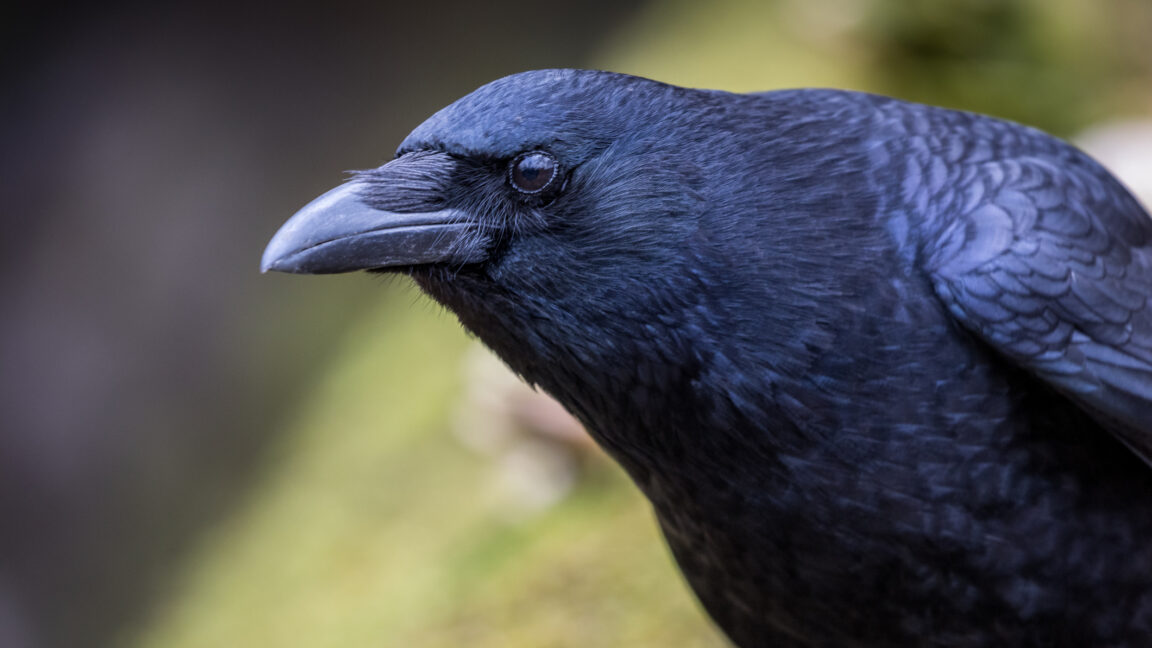
Carrion crows evaluate visual information about twice as fast as monkeys without losing accuracy, according to a study led by neurobiologist Andreas Nieder of Germany's University of Tübingen and published in Science in 2026. The result shows that bird brains, which lack the mammalian neocortex, reach decisions using the same mathematical logic as primate brains.
The task
Much of what is known about decision-making in the brain comes from monkeys performing a random-dot-motion task. The subject watches a cloud of dots drifting weakly in one direction and must judge whether, and in which direction, it moves. In primates, neurons gather visual evidence over time until their firing reaches a threshold and the animal commits to a choice.
Nieder and colleague Philipp Schmidbauer gave the same task to two hand-raised crows. The birds viewed white dots on black on a touch-sensitive monitor, with some share of the dots moving together left, right, up or down. They reported the direction by pecking one of the targets beside the display and received a mealworm for correct answers. The share of coherently moving dots ranged from 81 percent down to 3 percent, with an additional zero percent condition that had no correct answer. Both birds beat chance even at 3 percent.
Speed and neurons
From the appearance of the dots to the start of the head turn, the crows averaged 235 milliseconds. In closely matched studies, monkeys took roughly 410, 490 and 600 milliseconds. Nieder said the birds were not trading accuracy for speed: they performed as well as monkeys or humans.
The team recorded 248 neurons in the NCL, a region regarded as the functional counterpart of the primate prefrontal cortex. Of these, 58 fired differently depending on the direction the bird later chose, with the signal appearing about 70 milliseconds after the dots showed up.
Possible explanations
The researchers cannot point to a single faster process. Nieder suggests a cascade of faster processes, from vision to motor response. He cites birds' small, densely packed neurons with shorter axons, and higher body temperature, up to 41–42 °C versus about 36.6 °C in humans.
There are caveats: the study involved only two birds, and results may not extend beyond corvids, since less intelligent birds are hard to train for this task.


