Canada's dairy supply management faces renewed pressure from Trump tariffs
U.S. President Donald Trump is once again targeting Canada's dairy supply management system, citing it as unfair and using it to justify a 50% tariff on $20 billion worth of Canadian goods set to take effect in August.
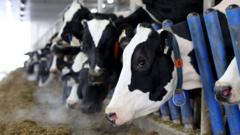
Canada's dairy industry policy, long considered politically sacrosanct, is back in the spotlight after U.S. President Donald Trump singled it out as one of three main irritants justifying a 50% tariff on C$20 billion worth of Canadian imports, effective August. Trump argues the system—which includes production quotas, set pricing, and import quotas for dairy, eggs, and poultry—is "unreasonable" for American farmers wishing to sell north of the border.
Canadian politicians have indicated dairy is non-negotiable. Quebec Premier Christine Fréchette said Tuesday that supply management is non-negotiable, and U.S.-Canada Trade Minister Dominic LeBlanc told the BBC it is "a cornerstone of Canada's economy and our rural communities" ensuring high-quality dairy products. Dairy farmers have staged protests with tractors and cattle on Parliament Hill when concessions loomed. David Clement, a Canadian policy director at the Consumer Choice Center, calls it "the most powerful political lobby in the country," spanning all major parties.
The system, in place since the early 1970s, has endured while other Commonwealth nations like Australia and New Zealand phased out similar policies. Farmers hold production quotas limiting output; prices are set by provincial marketing boards, providing predictable income. Foreign dairy enters tariff-free only up to small quotas; beyond that, tariffs of 200% to nearly 300% apply. Currently, U.S. producers have tariff-free access to just 3.5% of Canada's market, though Canada imported $1.3 billion in U.S. dairy in 2025 (USDA data). American farmers seek greater access due to record-high domestic production.
A White House order claims Canada's free trade agreement with the EU gives European cheese producers easier access than U.S. producers, labeling it discrimination. The previous Biden administration twice challenged Canada's dairy quota practices under the USMCA. In 2024, the UK walked away from trade talks over tariff-free access for British cheese. The OECD has also criticized the system for distorting production and trade.
Some Canadian economists and pundits call for reform. Jen Gerson called it "anachronistic" and blamed it for high food prices. Clement argues Trump "has a point" and that the system inflates prices, saying Canada should abolish it for its own benefit. Statistics Canada and USDA data show Canadians paid an average C$3.19 per litre of milk in May versus US$1.95 (converted) in the U.S. However, 77% of Canadians support keeping the system, according to polls. David Wiens, president of Dairy Farmers of Canada, says it provides stable prices and food sovereignty, shielding Canadians from price spikes like U.S. egg prices after bird flu. Opponents attribute public support to lack of awareness. Changing the system would cost billions in compensation and political seats, says professor Ryan Cardwell, concluding it is "not going anywhere."
/nginx/o/2026/10/02/17951290t1hc23f.jpg)

