Latvia's Transport Ministry urges drivers to switch to winter tyres early and slow down
After fatal road crashes this October, Latvia's Ministry of Transport is urging drivers to choose speeds suited to conditions and change tyres in good time. Winter tyres are mandatory from 1 December to 1 March.
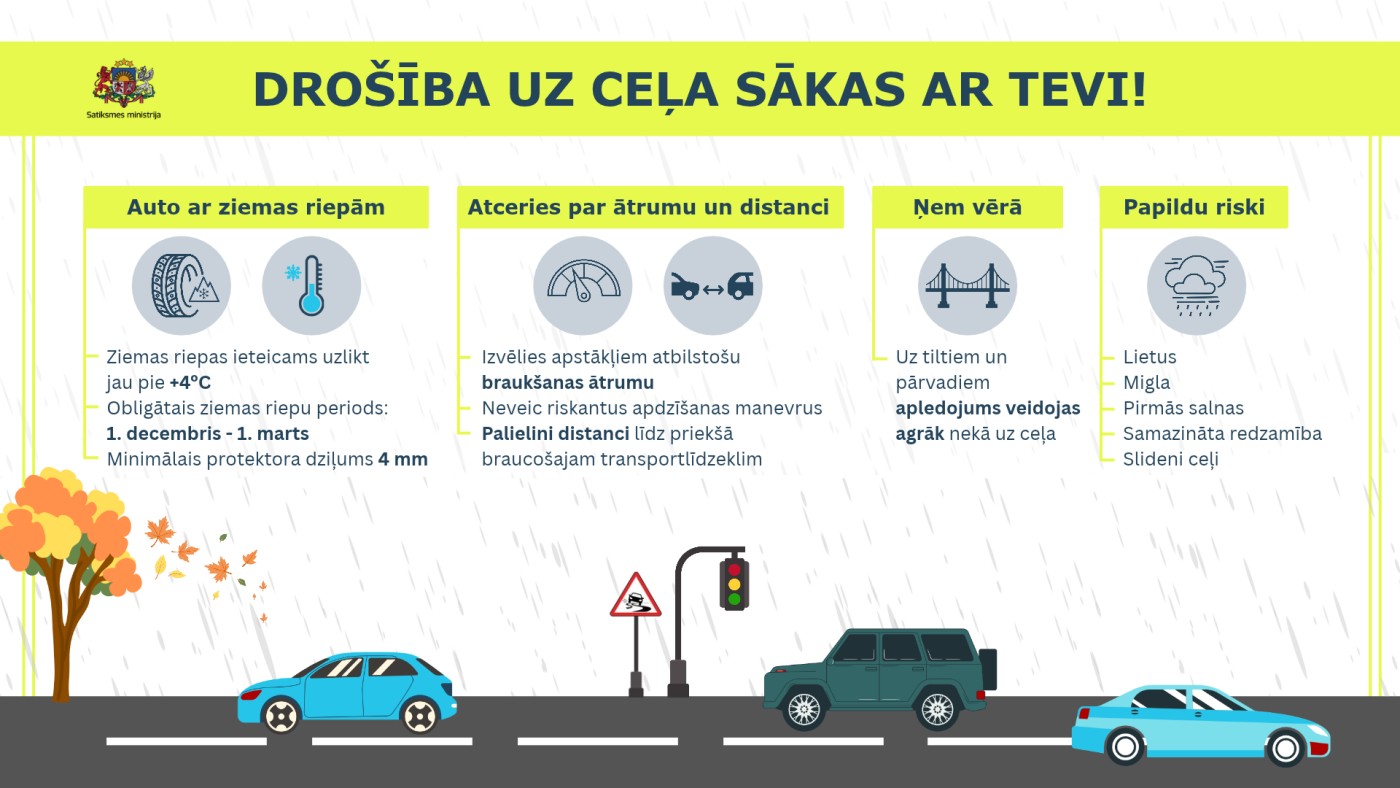
Latvia's Ministry of Transport, which is responsible for national transport policy, says this October's fatal road crashes show a trend unusual for the season. Besides the higher autumn risk to pedestrians and other vulnerable road users, vehicle collisions and cars leaving the road, including hitting a tree, have also cost lives. The ministry is calling on drivers to adapt their driving to autumn and winter conditions now.
Speed and overtaking
The ministry says the latest weekend crashes show the need to pick a speed that suits road and visibility conditions and to avoid risky overtaking. Jānis Kalniņš, director of the ministry's Road Transport Department, noted that Nordic studies indicate safety depends on a combination of factors: suitable speed, winter tyres fitted in good time, and cautious driving.
Changing tyres
Autumn weather changes road grip, especially during sharp temperature swings, precipitation and the first frosts. When air temperature nears +4 °C or falls lower, drivers are advised to assess whether summer tyres are still suitable and switch to winter tyres without waiting for the mandatory period. Winter tyres give better grip, shorter braking distances and greater stability at low temperatures, even when there is no snow or ice yet.
Under regulations, from 1 December to 1 March all passenger cars and trucks with a gross weight of up to 3.5 tonnes must have winter tyres. Tread depth must be at least 4 millimetres. The ministry recommends tyres with the 3PMSF marking (Three-Peak Mountain Snowflake, a mountain with three peaks and a snowflake), which confirms compliance with EU standards for difficult winter conditions.
Bridges and overpasses
Particular caution is needed on bridges, overpasses and damp road sections, where icing can form earlier than on the rest of the road. Finland's road safety organisation Liikenneturva also notes that such structures cool from both above and below. Drivers should keep a larger distance and avoid sudden manoeuvres, since even above freezing, grip on some sections can be considerably reduced.